Eye problems do not always announce themselves with dramatic vision loss. Sometimes the first clue is a headache that keeps showing up after computer work. Maybe headlights suddenly seem harsher at night, your contacts become uncomfortable by lunchtime, or your prescription seems to change faster than it used to.
Those small changes are easy to dismiss, especially when you can still read, work, and get through the day.
Paul Michael Mann, MD, FACS, from Mann Eye Institute, notes that comprehensive eye care looks at more than how clearly someone reads an eye chart and for anyone considering an eye doctor in Austin, recurring symptoms and personal health risks can provide useful clues about when an exam makes sense.
Some of these signs can wait for a routine appointment. Others deserve faster attention.
Recurring headaches can sometimes start with your vision
1. Headaches keep appearing after reading or screen work
Headaches have many possible causes, so it is important not to assume that every headache begins with the eyes. Still, vision problems can sometimes contribute.
The National Eye Institute lists headaches, eye strain, squinting, blurry vision, and difficulty focusing during reading or computer use among possible symptoms of refractive errors such as nearsightedness, farsightedness, astigmatism, and presbyopia [1].
If the headaches keep returning after the same kinds of visual tasks, mention that pattern during your exam.
Consider mentioning headaches at an eye exam when they regularly appear after:
- long periods at a computer
- reading small print
- switching repeatedly between near and distant tasks
- driving
- working while wearing an older prescription
You may simply need an updated prescription. Your eyes may also be working harder than necessary to keep things in focus.
If you already wear glasses or contacts, do not assume the prescription is still right simply because you can function with it. Vision can change gradually enough that you compensate without noticing.
An eye exam can determine whether focusing problems are part of the picture. If your prescription turns out to be fine, that information is useful too because headaches can then be investigated from another angle rather than repeatedly being blamed on your eyesight.
Night driving problems are worth mentioning
2. Headlights, halos, and dark roads are becoming harder to manage
Night driving places different demands on vision than reading an eye chart in a brightly lit room.
You may first notice the change when headlights seem unusually bright, street signs become harder to pick out, or you start avoiding unfamiliar roads after sunset. Some people notice halos around lights or feel that they need more time to adjust between brightly lit and dark areas.
An outdated prescription can contribute to glare and halos [1]. Cataracts can also make night vision more difficult and cause headlights or other lights to seem too bright [2].
Cataracts develop when the normally clear lens inside the eye becomes cloudy. They usually progress gradually, which means the first noticeable problem may not be obvious daytime blur. Night driving can become frustrating well before someone feels that their eyesight is generally poor.
A useful question is not simply, “Can I still drive?”
Instead, notice whether driving has changed your behavior. Are you leaving events early so you can get home before dark? Asking someone else to drive more often? Missing turns because signs become visible too late?
Those changes deserve to be mentioned during an exam.
Difficulty at night does not automatically mean cataracts, and cataracts do not automatically mean surgery. An exam can help determine whether the issue is a prescription change, cataract development, or another cause of reduced visual quality.
Redness, contact lens discomfort, and changing vision need context
Redness, contact lens discomfort, and gradual vision changes are easy to put off because they often feel manageable at first.
3. Your eyes are repeatedly red or irritated
Occasional redness after a poor night’s sleep or exposure to smoke may settle on its own. Redness that returns frequently deserves more attention, especially when it is accompanied by pain, light sensitivity, discharge, or reduced vision.
There is no single explanation for a red eye. Irritation, dryness, allergies, infection, inflammation, and other eye problems can all produce similar-looking symptoms.
That is one reason repeatedly treating the appearance of redness without understanding the cause can be unhelpful.
Severe eye pain together with a red eye, blurred vision, and nausea can be a warning sign of acute angle-closure glaucoma and requires urgent medical attention [7].
For less dramatic but recurring redness, keep track of when it appears. Does it happen after contact lens wear? Only at the end of the workday? During allergy season? That pattern can give the eye doctor more useful information than simply saying, “My eyes get red sometimes.”
4. Your contact lenses no longer feel comfortable
Contacts that were once easy to wear should not suddenly feel like something you have to endure.
Dryness, burning, grittiness, fluctuating vision, or needing to remove lenses earlier and earlier can signal an ocular-surface problem or a change in how well your lenses are working for you.
A systematic review and meta-analysis involving 48 studies found contact lens wear to be associated with a higher risk of dry eye. Screen use, allergies, thyroid disease, diabetes, migraines, and several other factors were also associated with dry eye risk [3].
Persistent discomfort should not be treated as a normal part of wearing contact lenses.
If you develop eye pain, marked redness, light sensitivity, or sudden blurred vision while wearing contacts, remove the lenses and contact an eye doctor promptly [8].
Sometimes the answer is relatively simple: different lenses, adjusted wearing time, or treatment for dryness. The important part is finding out why the experience has changed.
5. Your vision or prescription seems to be changing more often
A gradual prescription change can be perfectly ordinary. Frequent changes, new distortion, or vision that fluctuates from day to day deserve a conversation.
Refractive errors commonly cause blur, glare, halos, squinting, and trouble focusing [1]. Cataracts may also produce blurry vision and increasingly frequent changes in glasses or contact lens prescriptions [2].
Diabetes can affect the eyes before obvious symptoms develop, which is one reason comprehensive dilated eye examinations are particularly important for people with diabetes [6].
Do not focus only on whether things look “more blurry.” Pay attention to the character of the change:
- Is one eye noticeably different from the other?
- Does vision clear after blinking?
- Are straight lines starting to look distorted?
- Is the problem mainly near, far away, or in dim light?
- Has your prescription changed several times in a short period?
Those details help separate a routine correction issue from something that may need broader evaluation.
Flashes, floaters, and sudden changes should not wait
Most of the signs above can be discussed at a scheduled visit. The next two call for faster attention.
6. You suddenly develop many new floaters, flashes, or a shadow in your vision
Floaters can look like dots, threads, cobwebs, or small shapes moving across your vision. Many people have a few longstanding floaters that are harmless.
What matters most is whether those floaters or flashes are new or suddenly increasing.
Research reviewing symptoms associated with posterior vitreous detachment found that retinal-tear risk was higher when flashes and floaters occurred together, particularly when people described numerous new floaters or a cloud or curtain in their vision [4].
The National Eye Institute identifies a sudden increase in floaters, flashes of light, and a curtain or shadow over part of the visual field as warning signs of retinal detachment. Retinal detachment is a medical emergency and requires immediate evaluation [5].
This is not a situation to monitor for several days to see whether it improves.
Seek urgent eye care or emergency evaluation if you suddenly notice:
- many new floaters
- flashes of light
- a dark curtain or shadow
- a missing area of vision
- sudden substantial vision loss
Many people evaluated for new flashes or floaters will not have a retinal detachment. The reason for acting quickly is that you cannot safely make that distinction at home.
7. Your health history puts your eyes at higher risk even when you feel fine
Your health history matters even when your vision seems normal. Some eye diseases develop with few noticeable symptoms, so factors such as diabetes, high blood pressure, age, and family history can affect how often your eyes should be examined.
The National Eye Institute recommends discussing examination frequency with an eye doctor if you have diabetes or high blood pressure. It also identifies age and a family history of glaucoma among factors that can increase the need for regular dilated examinations [6].
Glaucoma is a good example of why symptoms are not the whole story. The most common form often causes no noticeable problems early on, and gradual peripheral vision loss may go unnoticed until the disease has progressed [7].
Tell your eye doctor about:
- diabetes or high blood pressure
- a family history of glaucoma or significant eye disease
- medications that may affect the eyes
- previous eye surgery or injury
- major changes in your general health
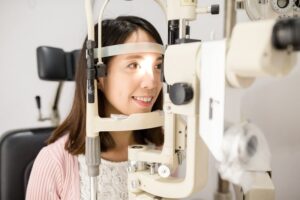
A comprehensive exam can include more than a prescription check. Depending on your needs, it may involve eye-pressure measurement, peripheral-vision testing, dilation, and examination of the retina and optic nerve [6].
Your health history may justify regular eye exams even when your vision feels unchanged.
When symptoms point beyond a simple prescription change, having access to both optometric and ophthalmic evaluation can make the next step more straightforward. Mann Eye Institute provides both types of care in the Austin area.
If a vision change keeps interfering with reading, work, driving, or contact lens wear, bring it up at an exam. Sudden changes, especially flashes, many new floaters, or a shadow in your vision, need faster attention.
References
[1] National Eye Institute. (2025, December 19). Refractive errors. https://www.nei.nih.gov/eye-health-information/eye-conditions-and-diseases/refractive-errors
[2] National Eye Institute. (2025, November 26). Cataracts. https://www.nei.nih.gov/eye-health-information/eye-conditions-and-diseases/cataracts
[3] Qian, L., & Wei, W. (2022). Identified risk factors for dry eye syndrome: A systematic review and meta-analysis. PLoS ONE, 17(8), e0271267. https://doi.org/10.1371/journal.pone.0271267
[4] Gishti, O., van den Nieuwenhof, R., Verhoekx, J., & van Overdam, K. V. (2019). Symptoms related to posterior vitreous detachment and the risk of developing retinal tears: A systematic review. Acta Ophthalmologica, 97(4), 347–352. https://doi.org/10.1111/aos.14012
[5] National Eye Institute. (2025, November 5). Retinal detachment. https://www.nei.nih.gov/eye-health-information/eye-conditions-and-diseases/retinal-detachment
[6] National Eye Institute. (2025, November 26). Get a dilated eye exam. https://www.nei.nih.gov/eye-health-information/healthy-vision/finding-eye-doctor/get-dilated-eye-exam
[7] National Eye Institute. (2025). Glaucoma. https://www.nei.nih.gov/eye-health-information/eye-conditions-and-diseases/glaucoma
[8] Centers for Disease Control and Prevention. (2025, May 27). What causes contact lens-related eye infections. https://www.cdc.gov/contact-lenses/causes/index.html