Introduction
You wake up congested, groggy, and desperate to breathe through your nose, so you grab whatever looks familiar from the medicine cabinet. Then the question hits: can i take sudafed and dayquil at the same time, or is that a fast way to double up on something you should not? For a lot of people, this is not just a casual question. It matters because brand names can make two products seem completely different even when they overlap in ways that count.
The reason this gets confusing is simple. Standard DayQuil Cold & Flu products commonly contain acetaminophen, dextromethorphan, and phenylephrine. Sudafed, on the other hand, may contain pseudoephedrine if it is the regular behind-the-counter version, or phenylephrine if it is Sudafed PE. That means the answer depends less on the word “Sudafed” and more on the active ingredient printed on the box.
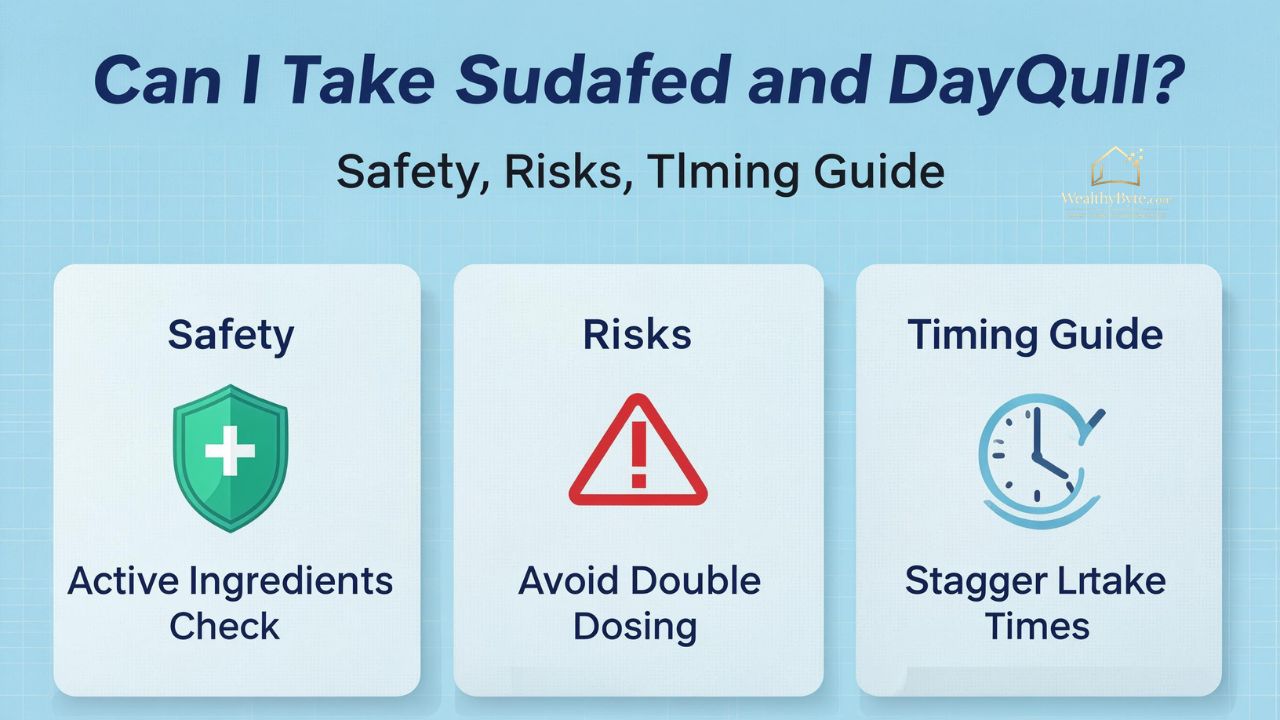
Most people do not need a chemistry lesson when they have a cold. They need a plain-English answer they can trust. The safest approach is to stop thinking in brand names and start thinking in symptom ingredients: pain reliever, cough suppressant, and decongestant. Once you do that, the overlap becomes much easier to spot.
This guide walks through what is in each medicine, when the combination is more likely to be a bad idea, what side effects matter most, and what to do instead when you want relief without guessing. It is written for adults looking for general information, not for children or for people following a clinician’s personalized plan.
Image suggestion: A simple comparison graphic labeled “Brand Name vs Active Ingredient.”
Can I Take Sudafed and DayQuil?
In many cases, can i take sudafed and dayquil is really the wrong question. The better question is: which Sudafed product are you holding? If your product is Sudafed PE, it already uses phenylephrine, and standard DayQuil also contains phenylephrine. Taking both would duplicate the same oral decongestant. If your product is regular Sudafed with pseudoephedrine, the answer still is not an automatic yes, because you would be stacking one decongestant on top of another.
Here is the cleanest way to think about it:
- DayQuil Cold & Flu: acetaminophen + dextromethorphan + phenylephrine
- Sudafed PE: phenylephrine
- Regular Sudafed: pseudoephedrine
- Some Sudafed combo products: may also include pain relievers or other ingredients, depending on the formula
That is why label reading matters more than the brand logo. A person can think they are combining a “cold medicine” with a “sinus medicine,” when in reality they are taking two oral decongestants or adding an extra ingredient they did not plan for. MedlinePlus also warns people to read nonprescription combination labels carefully before using two or more products at the same time.
Why the answer gets confusing so often
Brand families make this harder than it should be. “Sudafed” can mean pseudoephedrine or phenylephrine depending on the exact product. “DayQuil” can also come in different formulas, including severe versions and high-blood-pressure versions, so the front of the box does not tell the whole story. The active ingredient panel does.
There is also a practical reason people ask this question. When congestion is intense, one medicine may not feel like enough. That can tempt you to layer another product. But taking more medicines does not always mean better relief. Sometimes it only means more side effects, more label confusion, and a higher chance of doubling up on the wrong ingredient.
Image suggestion: Infographic comparing DayQuil, Sudafed, and Sudafed PE by active ingredient and overlap risk.
When can i take sudafed and dayquil become a bad idea?
The clearest no is DayQuil plus Sudafed PE. Both contain phenylephrine, so you would be repeating the same type of decongestant. That is not a smart mix to improvise at home. It adds overlap without solving the real problem of ingredient duplication.
The grayer area is DayQuil plus regular Sudafed with pseudoephedrine. These are not the exact same ingredient, but they are both oral decongestants. Because both products carry warnings related to heart disease, high blood pressure, thyroid disease, diabetes, and trouble urinating from an enlarged prostate, combining them should not be treated like a routine, casual choice. For many adults, the safer rule is to pick one decongestant strategy rather than stacking two.
If a pharmacist or clinician tells you your exact products can be used together for a short period, that advice should be based on your ingredients, your medical history, and your dose timing. That is different from assuming any Sudafed and any DayQuil are fine because both are sold over the counter. Over-the-counter does not mean risk-free.
What is actually in DayQuil that matters?
DayQuil is not just a decongestant. Standard DayQuil Cold & Flu products typically combine three types of medicines in one dose: acetaminophen for pain and fever, dextromethorphan for cough, and phenylephrine for nasal congestion. Severe formulas may also add guaifenesin for mucus. That means when you combine DayQuil with something else, you are not only thinking about congestion. You also have to think about acetaminophen totals and cough-suppressant overlap.
The DayQuil label also carries several warnings that people skip when they are sick. It says not to use it with other drugs containing acetaminophen, and not to use it if you are taking an MAOI or have taken one within the last two weeks. It also tells people to ask a doctor before use if they have liver disease, heart disease, high blood pressure, thyroid disease, diabetes, or trouble urinating due to an enlarged prostate.
That is why the question can i take sudafed and dayquil cannot be answered safely by looking at only one ingredient. DayQuil already does several jobs at once. The moment you add another cold medicine, the chance of hidden overlap jumps.
The biggest risks people miss
Doubling up on decongestants
This is the most common problem. Phenylephrine and pseudoephedrine are both decongestants. They work by narrowing blood vessels in the nasal passages to reduce swelling and ease congestion. That same mechanism is why these products come with warnings for people who have heart disease or high blood pressure. Taking two decongestants together can make side effects like nervousness, dizziness, or sleeplessness more likely.
Accidentally taking too much acetaminophen
DayQuil contains acetaminophen, which shows up in a huge number of cold, flu, and pain products. MedlinePlus says not to take more than 4,000 mg of acetaminophen per day from all sources, and the DayQuil label warns about severe liver damage if you take more than the product’s daily maximum, combine it with other acetaminophen products, or use it while drinking three or more alcoholic drinks daily.
This is one reason people get into trouble even when Sudafed itself does not contain acetaminophen. They may take DayQuil, then add Tylenol, then take a nighttime cold medicine later, not realizing the same pain reliever is hiding in more than one product. The labels matter because the math adds up fast.
Missing medicine interactions
Dextromethorphan, the cough suppressant in DayQuil, is another ingredient worth checking. DayQuil labeling warns against using it with MAOI medications or within two weeks of stopping one. Similar MAOI warnings also appear on pseudoephedrine and phenylephrine labels. If you take prescription medicines for depression, Parkinson’s disease, or other conditions, it is smart to ask a pharmacist before you improvise with combination cold products.
Overlooking your health history
People with high blood pressure, heart disease, thyroid disease, diabetes, or prostate-related urinary symptoms should not guess with oral decongestants. These warnings are not buried in obscure literature. They are right on the consumer drug labels for phenylephrine and pseudoephedrine products, and DayQuil carries several of the same cautions.
Pregnant or breastfeeding adults should also check with a health professional before using these decongestants, because those warnings appear on the consumer labels as well.
Before you decide can i take sudafed and dayquil, read the label this way
When you are tired and stuffed up, label reading feels annoying. It only takes about a minute if you know where to look.
1. Find the active ingredients, not the marketing name
Look for words like pseudoephedrine, phenylephrine, acetaminophen, dextromethorphan, and guaifenesin. Ignore phrases like “sinus,” “severe,” or “maximum strength” until you know what the ingredients actually are.
2. Circle the ingredient doing the job you want
If your main problem is congestion, choose one decongestant plan. If your main problem is cough, focus on the cough ingredient. This keeps you from swallowing a multi-symptom medicine for symptoms you do not even have.
3. Check for hidden repeats
Ask yourself three quick questions:
- Does this second product contain another decongestant?
- Does it add more acetaminophen?
- Does it bring in a cough suppressant I am already taking?
4. Read the warning box, not just the dose
The warning box tells you who should ask a doctor first, which interactions matter, and what side effects should make you stop. That is where the high blood pressure, liver disease, prostate, diabetes, and MAOI warnings usually appear.
Smarter ways to get relief without stacking oral decongestants
If your real goal is simply “I want to breathe,” there are often easier options than doubling up on DayQuil and Sudafed. MedlinePlus recommends self-care steps such as rest, plenty of fluids, a cool-mist humidifier, and saline nose drops or sprays for cold symptoms. Those options can be especially helpful when you want congestion relief without adding another systemic medicine.
A better practical plan often looks like this:
- Use one oral decongestant approach, not two
- Use saline spray or a humidifier to support congestion relief
- Use a single-ingredient pain reliever only if you truly need it, while keeping track of total acetaminophen
- Ask a pharmacist for a symptom-based combination that matches your medical history
This is also where the question can i take sudafed and dayquil becomes less important than “What symptom am I treating?” Once you match the medicine to the symptom, there is less temptation to layer brand-name products that overlap.
Who should be extra careful
You should slow down and check with a pharmacist or clinician before combining these medicines if any of the following apply to you:
- You have high blood pressure
- You have heart disease
- You have thyroid disease
- You have diabetes
- You have trouble urinating because of an enlarged prostate
- You have liver disease
- You are pregnant or breastfeeding
- You take an MAOI or recently stopped one
- You are already taking another cold, flu, allergy, or pain medicine
For these groups, the question can i take sudafed and dayquil should almost never be answered by guesswork.
When to stop self-treating and get help
If your symptoms are getting worse instead of better, do not keep adding medicines and hoping for the best. MedlinePlus says to contact a provider right away or go to the emergency room if you have difficulty breathing, sudden chest pain, sudden dizziness, or severe vomiting that does not go away. It also says to contact your provider if symptoms get worse or do not improve after about 10 days. DayQuil and decongestant labels also say to stop use and ask a doctor if nervousness, dizziness, or sleeplessness occur, or if symptoms do not improve within 7 days or happen with fever.
FAQ
Can I take Sudafed and DayQuil at the same time?
Not as a default. If your Sudafed is Sudafed PE, standard DayQuil already contains phenylephrine, so that is duplicate decongestant use. If it is regular Sudafed with pseudoephedrine, you are still stacking oral decongestants, which is why many people should check with a pharmacist instead of assuming it is fine.
Is Sudafed PE the same as regular Sudafed?
No. Sudafed PE products use phenylephrine, while regular Sudafed products use pseudoephedrine. They are both decongestants, but they are not the same ingredient.
Does DayQuil already have a decongestant in it?
Yes, standard DayQuil Cold & Flu products commonly contain phenylephrine along with acetaminophen and dextromethorphan. Severe versions may also include guaifenesin.
Why do people get into trouble with DayQuil?
Usually because it is a combination medicine. People remember it as a “cold product” and forget that it may already contain a pain reliever, a cough suppressant, and a decongestant. That makes overlap with other medicines easier than most people realize.
Can I take Tylenol with DayQuil?
Be careful. DayQuil already contains acetaminophen, which is the active ingredient in Tylenol. MedlinePlus says not to exceed 4,000 mg of acetaminophen per day from all sources, and the DayQuil label warns not to combine it with other acetaminophen-containing drugs.
What if I have high blood pressure?
That is a situation where you should not guess. Phenylephrine and pseudoephedrine labels both tell people with high blood pressure to ask a doctor before use, and DayQuil labeling carries the same type of warning.
What can I use instead of combining both?
Many people do better with one symptom-focused medicine plus non-drug support such as rest, fluids, saline spray, and a cool-mist humidifier. That gives relief without piling on extra ingredients you may not need.
Should I ask a pharmacist even if both are over the counter?
Yes, especially if you take prescription medicines, have a chronic condition, or are unsure which Sudafed product you bought. Over-the-counter status does not remove the interaction and warning issues printed on the label.
Conclusion
So, can i take sudafed and dayquil? The honest answer is that you should not treat it like a simple yes-or-no brand-name question. If your Sudafed is Sudafed PE, avoid the combo because DayQuil already contains phenylephrine. If your Sudafed is regular pseudoephedrine, the choice still deserves caution because you may be stacking decongestants and increasing side effects. The safest habit is to read the active ingredients, pick one decongestant strategy, and ask a pharmacist when the label leaves any doubt.
If you want, I can also turn this into a cleaner publish-ready blog format with tighter paragraphs and WordPress-friendly styling.